Understanding Artificial Intelligence (AI)
Artificial Intelligence (AI) is not just a buzzword; it is one of the most revolutionary fields of computer science. At its core, AI is the science and engineering of building machines that can think, learn, and act intelligently, almost like humans. These intelligent systems can perform tasks such as learning from data, solving problems, making decisions, understanding languages, and even recognizing images or voices. Technically, AI is built upon three pillars: data (the raw information), algorithms (the set of rules), and computational power (the processing strength that makes everything possible). What makes AI unique compared to traditional software is its ability to improve over time. Instead of blindly following pre-written instructions, AI can adapt, evolve, and refine its results the more information it processes. Think of it like a student in school: at first, the student makes mistakes, but with practice and guidance, they get better day by day. That is exactly how AI systems grow smarter — not overnight, but through continuous learning and pattern recognition.
Real-Life Connection: How AI Relates to Us
To make this concept less technical, let’s compare it to how a child learns. Imagine teaching a small child the names of fruits. You show them an apple and say, “This is an apple.” The first few times, they might get confused, but eventually, they point to an apple and say the word themselves. Later, even if the apple is green or bigger in size, the child still recognizes it as an apple because they’ve learned the concept behind it. AI works the same way. The only difference is that instead of a child, it’s a machine; instead of parents teaching, we feed it data — like thousands of pictures of apples. Over time, AI starts recognizing apples in new images, no matter their shape or color. That’s why when you unlock your phone with face recognition, or when YouTube suggests the next video, it feels like the machine already knows you. It has “seen” enough of your behavior patterns to predict what you want next.

My First Step into the World of AI
My First Step into the World of AI
When I first heard about Artificial Intelligence, I thought it only belonged in movies where robots talk, think, and sometimes even take over the world. My perspective changed the day I worked on a small project that involved handwriting recognition. The program’s task was simple: identify whether I had written the number “3” or “8.” At the beginning, it failed miserably, often confusing my numbers and giving wrong results. I laughed at how “dumb” the machine seemed. But then I trained it with more data — thousands of samples of handwritten numbers from different people. Slowly, the accuracy improved, and one day it correctly identified even my poorly written “3.” That moment felt magical. It was like watching a child finally understand something after repeated practice. I realized AI was not about replacing humans but about machines learning step by step, just like we do
Applications of Artificial Intelligence in Real Life
Examples – AI Around Us Every Day
Artificial Intelligence often feels like something that belongs to the future, but in reality, it is deeply woven into our daily routines. Sometimes we don’t even notice that we are using AI, because it works so smoothly in the background. Let’s open up a few examples in detail:
- Healthcare – Smarter Diagnosis
Doctors today are supported by AI systems that can study X-rays, MRI scans, or even blood reports to detect diseases like cancer or pneumonia at an early stage. These systems are trained on millions of medical images, so they can notice even the tiniest pattern that a human eye might miss. For example, an AI tool might highlight a small spot on an X-ray which could be the start of a disease, giving doctors a chance to treat it earlier and save lives. - Education – Personalized Learning
Every student learns differently: some are fast learners, while others need more time to understand. AI-powered learning apps like Duolingo or Byju’s track how you study — what you get right, where you struggle, and how much time you spend. Based on this, the app suggests the next lesson at your pace. It’s like having a personal tutor available 24/7, one who never gets tired and always adjusts to your style. - Travel – Smarter Navigation
When you open Google Maps to find directions, AI immediately checks real-time traffic conditions by analyzing data from thousands of phones moving on the road. If one route has heavy traffic, the app automatically suggests a quicker alternative. Sometimes, it even predicts how traffic will look 30 minutes later, based on past data patterns. This is why AI navigation feels so accurate — it’s constantly learning from live data. - Entertainment – Tailored to Your Taste
Platforms like Netflix, YouTube, and Spotify use AI to study your watching or listening habits. For example, if you often watch thrillers, Netflix will suggest more suspense movies. If you listen to calm music at night, Spotify will automatically recommend similar playlists. The AI compares your behavior with millions of other users to “guess” what you might like next. That’s why sometimes it feels like these apps know you better than your friends do! - Everyday Tools – The Helpful Assistants
Voice assistants like Siri, Alexa, and Google Assistant are AI in action. When you say, “Hey Siri, set an alarm for 6 AM,” your voice is converted into text, understood by an AI model, and then executed as a task. The more you use them, the smarter they get at understanding your accent, language, and preferences. They can even answer random questions, control your smart home devices, or tell jokes to keep you entertained.
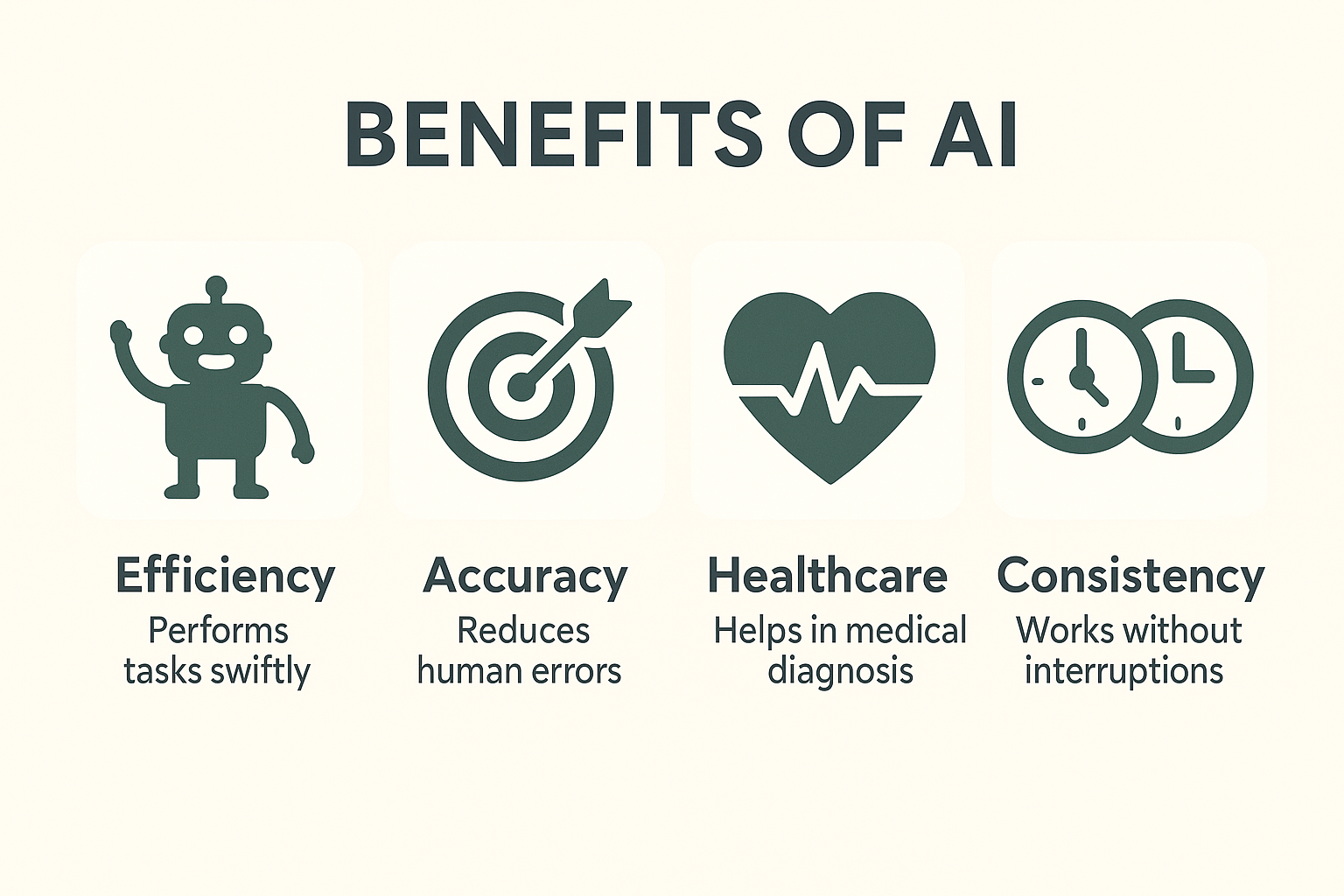
Artificial Intelligence is often described as one of the greatest technological revolutions of the 21st century. Unlike traditional machines that merely follow instructions, AI has the ability to learn, adapt, and evolve. This makes it a powerful tool that is transforming almost every sector of human life. Let’s understand its pros in detail:
Doesn’t Get Tired & Wear Out Easily
Humans have physical and mental limits — we get tired after working long hours. AI systems, however, can work continuously 24/7 without fatigue. For example, chatbots in customer support answer queries late at night when humans are sleeping. Similarly, robots in factories assemble products tirelessly, ensuring productivity never drops. This makes AI reliable for tasks requiring constant attention.
2. Rational Decision Maker
Humans often let emotions influence decisions. AI, on the other hand, depends on data and logic. For instance, in financial markets, AI algorithms analyze vast data to make investment suggestions purely on facts, not on fear or excitement. This rationality helps businesses and industries reduce errors caused by human emotions.
3. Applications in Medical Industry
Healthcare has seen one of the most impactful uses of AI. Machines can scan X-rays and MRIs, detecting diseases like cancer at early stages, sometimes more accurately than doctors. During the COVID-19 pandemic, AI helped track infection trends and predict future outbreaks. For patients, this means faster diagnosis and better treatment.
4. Accurate Decision Making
AI systems are trained on millions of data points, which gives them precision. For example, weather forecasting has become much more accurate because AI considers countless variables humans cannot process at once. In traffic systems, AI-powered Google Maps suggests routes in real-time, saving people both time and fuel.
5. Selfless with No Breaks
Unlike humans, AI does not ask for leaves, breaks, or holidays. Voice assistants like Alexa and Siri respond instantly every time we call them. In industries like space exploration or mining where human survival is risky, AI-powered machines work tirelessly without personal needs. This makes them incredibly dependable.

A Human Story of Hope in Healthcare :-

Sameer’s grandmother had a rare disease. Doctors struggled for weeks to find the right treatment. Then one day, the hospital introduced an AI-powered diagnostic tool. Within minutes, it analyzed her reports and suggested a treatment plan that doctors later confirmed. Sameer still remembers how AI gave his family hope when they had almost lost it.
Benefits of Artificial Intelligence for Beginners
Artificial Intelligence (AI) is no longer a subject only for scientists or big tech companies. Today, AI is everywhere — from our smartphones to our classrooms, from healthcare to entertainment. For beginners, AI may sound complicated at first, but the truth is that it comes with plenty of advantages that make learning, working, and even daily life much easier.

1. Simple and Easy Learning :-
One of the biggest benefits of AI is that it makes learning easy for beginners. In the past, if you wanted to understand a new subject like programming, you had to read big books or join expensive courses. Now, AI tools like ChatGPT, Google Bard, or AI tutors can explain even the toughest concepts in very simple words.

 Example:
 If a beginner asks, “What is Python programming?” an AI assistant can give a clear answer with examples, step-by-step. This saves time and removes fear of starting something new.

2. Saves Time and Effort :-
AI helps beginners save hours of searching and confusion. Normally, if you search on Google, you may have to open 10–15 websites to find the correct answer. With AI, you just ask once, and you get the summary, explanation, and sometimes even a practical example instantly.

 This is very useful for students who are preparing for exams or beginners who are exploring new skills like coding, marketing, or design.

3. Hands-on Practice Without Expertise :-
Earlier, technology experiments were possible only for experts. But now, beginners can directly use AI to create amazing things — without being professional programmers or designers.

Example:
You can generate an image with just a text prompt.
You can write computer code with AI coding assistants.
You can make music, blogs, or videos using AI tools.
This hands-on practice gives beginners confidence that they can create something useful even at the starting stage.

4. Personalized Guidance :-
Every person learns differently — some like reading, some like watching videos, while others learn best with examples. AI understands this and adjusts itself according to your needs.

 example:
A beginner learning English can use AI language apps that practice conversation and correct grammar mistakes in real time.
A beginner in mathematics can ask AI to solve step-by-step problems with easy explanations.
This personalized guidance makes learning smooth, fun, and less stressful.

5. Low Cost Learning :-

Many beginners cannot afford expensive courses or private tutors. Here, AI becomes a true friend. Most AI tools are either free or much cheaper than traditional methods.

Example:
Apps like Duolingo use AI to teach languages almost for free.
AI-based websites and apps provide free tutorials, practice exercises, and doubt-solving.
This means anyone can start learning without worrying about money.

6. Better Career Opportunities :-
AI is the future, and beginners who understand it today will have better chances tomorrow. Even if you don’t want to become a data scientist, having basic knowledge of AI can help in almost every field.

 Example:
In marketing, AI helps in creating ads and analyzing customer behavior.
In finance, AI helps in fraud detection and stock predictions.
In healthcare, AI supports doctors in diagnosing diseases faster.
Artificial Intelligence is not a scary or complicated subject anymore. For beginners, it acts like a personal teacher, guide, and helper. It makes learning faster, simpler, and more enjoyable. From saving time to giving personalized lessons, from free learning resources to future career growth — AI offers everything a beginner needs to move forward with confidence.
The best part is, you don’t need to be an expert to start. Just curiosity and a little practice are enough to begin your AI journey today.
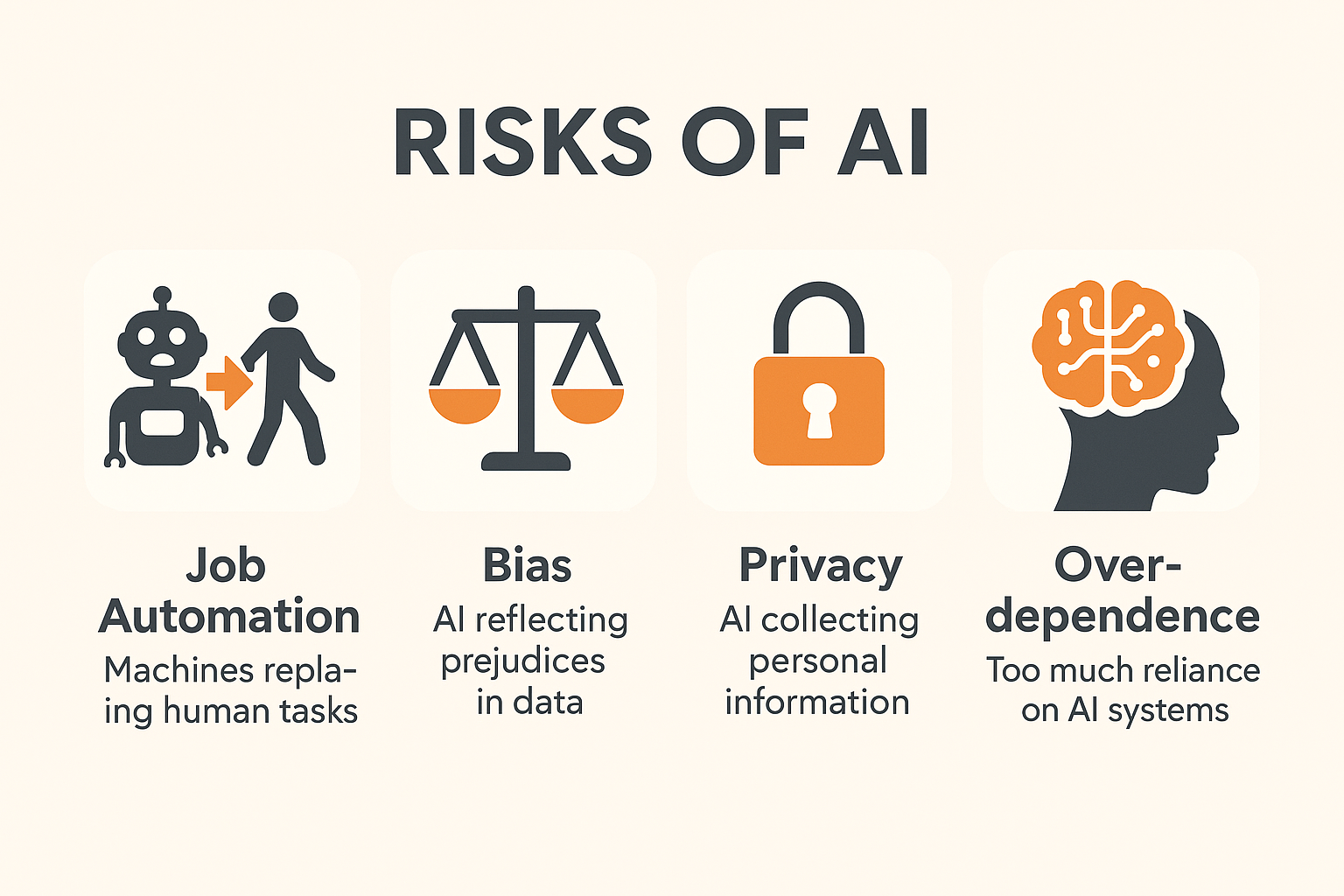
While AI offers many benefits, it also comes with significant challenges. Like any powerful tool, if not handled carefully, it can create problems for individuals, businesses, and society. Let’s explore the cons in detail:
1. Incurs High Cost
Developing and maintaining AI systems is expensive. Training advanced AI requires massive computing power, high-quality data, and skilled professionals. For example, self-driving car companies invest billions of dollars just to train AI models. Small businesses cannot afford such costs, which creates inequality in who can use AI technology.
2. Leads to Unemployment
One of the biggest concerns is job loss. Since AI machines can perform repetitive tasks better and faster, companies often replace humans with automation. For example, in factories, robots now handle packaging and assembly that thousands of workers once did. While new jobs in AI fields are being created, low-skilled workers are at risk of unemployment.
3. No Improvement with Experience
Unlike humans, who improve with age and experience, AI does not “mature” in the same way. It performs only as well as the data it is trained on. If a machine is trained poorly, it will keep repeating the same mistakes. For instance, an AI translation app will always make errors in grammar if the data was faulty, no matter how long it is used.
4. Lacks in Creativity
AI is brilliant at logic but weak in creativity. It can compose music, write essays, or generate art — but all based on patterns it has learned, not true imagination. For example, AI can suggest new recipe combinations, but it cannot “feel” the joy of cooking or invent something entirely new from emotions. True human creativity, empathy, and intuition cannot be replaced.

The Human Side of AI Job Loss :-
To truly understand the downside, imagine a man named Rakesh who worked in a car manufacturing factory for 15 years. He was proud of his job — assembling parts by hand, training newcomers, and earning enough to support his family.
But then, the company introduced robotic arms powered by AI. These machines worked faster, never took breaks, and didn’t make mistakes. Within a year, most workers in Rakesh’s section, including him, were laid off. He suddenly found himself unemployed, struggling to learn new skills in his 40s.
This story is not fiction — similar situations are happening worldwide. Workers in customer support, delivery services, and even journalism are feeling the pressure as AI starts doing tasks they once did. While AI helps companies grow, the human cost can be very painful if society does not prepare alternatives like reskilling programs and social support.

Want to explore more?
 Next: Explore the 3 Types of Artificial Intelligence →
Next: How Does AI Actually Work? →
Leave a Reply